> For the complete documentation index, see [llms.txt](https://help.vectary.com/llms.txt). Markdown versions of documentation pages are available by appending `.md` to page URLs; this page is available as [Markdown](https://help.vectary.com/documentation/3d-configurator/floating-ui/input.md).
# Input
### Overview
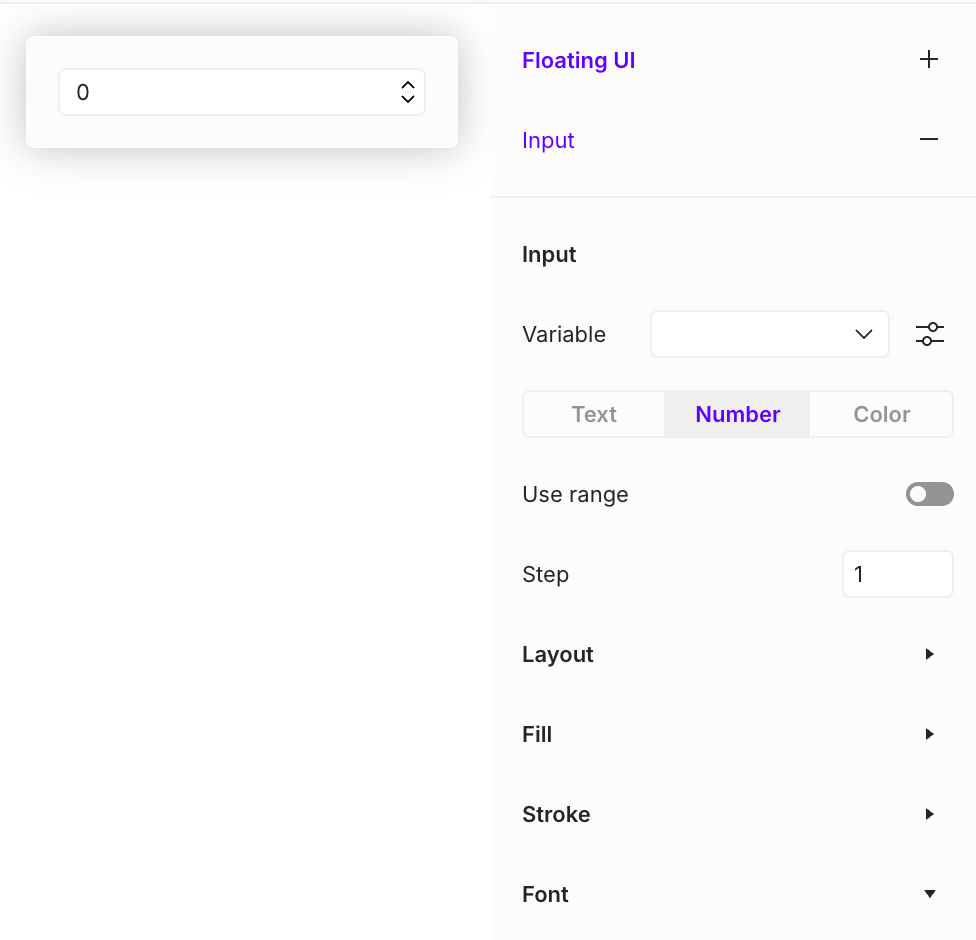
The **Input** element adds an editable field to Floating UI that allows end users to enter **text**, **numeric**, or **color** values. The value entered into the Input field updates the [variable](/documentation/3d-configurator/variables-and-expressions.md) specified in the Input settings.
By binding the Input element to a variable, it becomes possible to build interactive user interfaces where scene properties can be modified directly through user-defined values.
#### How the Input element works
* Input element is configured to target a specific variable
* Any value entered by the end user updates that variable in real time
* All Studio properties that reference the same variable respond immediately to the change
This approach enables flexible configurators where scene behavior and appearance are driven by user input.
### Settings
The primary configuration of the Input element consists of selecting an existing variable (variable is type-agnostic) and defining the mode in which the Input operates.
Available Input modes:
* **`Text`** - allows entering a text value
* **`Number`** - allows entering a numeric value
* **`Color`** - allows entering a color value in **HEX** or **RGB** format
All remaining settings of the Input element are purely visual and affect only its appearance in the Floating UI.
\
**Number-specific settings**
When **`Number`** mode is selected, additional configuration options become available:
* **Use range** - enables restricting input values to a defined range
* **Range** - defines the minimum and maximum allowed values
* **Step** - sets the increment for value changes (manual input values are automatically rounded according to the defined step)
### Text input example
This example demonstrates how to control a 3D text object using a text Input.
{% embed url="" %}
**Steps:**
* Create a **3D Text** object
* Create a variable in the Variables Manager
* In the 3D text content field, insert the variable using the following syntax:\
`${variable}`\
This syntax replaces the displayed text with the value of the variable\
The variable can also be embedded within text, for example:\
`Text ${variable} Text`
* Add Floating UI and create an **Input** element
* In the Input settings, select **Text** mode and assign the created variable
**Result: i**n Preview mode, entering text into the Input field updates the text displayed by the 3D Text object.
***
### Number input example
{% embed url="" %}
This example demonstrates how to control a numeric property, such as object scale.
\
**Steps:**
* Create a 3D object, such as a **Box**
* Create a variable in the Variables Manager
* Assign the variable to a numeric property, for example the **Scale X** value of the object
* Add Floating UI and create an **Input** element
* In the Input settings, enable **Number** mode and select the created variable
**Result:** in Preview mode, entering a numeric value into the Input field updates the object scale according to the entered value.
***
### Color input example
For interactive material color control, Floating UI provides a dedicated [**Color**](/documentation/3d-configurator/floating-ui/color.md) element with a color palette.\
The **Input** element can be used alongside the Color element or as an alternative method for color adjustment.
The mechanism follows the same principle as Text and Number modes:
* A variable is selected in the Input settings
* The end user enters a color value in the Input field
* Supported formats, such as **RGB** or **HEX**, are defined in the Input settings
When the same variable is used by both the Color element and the Input element, color changes can be made either visually through the palette or precisely through numeric color values.
---
# Agent Instructions
This documentation is published with GitBook. GitBook is the documentation platform designed so that both humans and AI agents can read, navigate, and reason over technical content effectively. Learn more at gitbook.com.
## Querying This Documentation
If you need additional information that is not directly available in this page, you can query the documentation by asking a question.
Perform an HTTP GET request on the following URL with the `ask` and `goal` query parameters:
```
GET https://help.vectary.com/documentation/3d-configurator/floating-ui/input.md?ask=&goal=
```
`ask` is the immediate question: it should be specific, self-contained, and written in natural language.
`goal` is what the user is ultimately trying to achieve, the reason they need the answer. Sharing it helps GitBook give you a better, more relevant answer. A goal is most helpful when it describes the outcome the user wants rather than restating the question. For example, with `ask=how do I create an API token`, a goal like `automate deployments from our CI pipeline` lets GitBook tailor the answer to that use case.
The response will contain a direct answer to the question and relevant excerpts and sources from the documentation.
Use this mechanism when the answer is not explicitly present in the current page, you need clarification or additional context, or you want to retrieve related documentation sections.